Skip to content

News

"One Student One Chip" Participates in the Pakistan Semiconductor Summit

From March 27 to 29, 2026, the "One Student One Chip" team traveled to Lahore to participate in the 2nd Pakistan Semiconductor Summit. This marked the first time "One Student One Chip" had engaged with South Asia, and we were honored to be the only foreign team present at the event. During the summit, we delivered three main presentations: a roundtable discussion by Dr. Yu Zihao, a poster showcase of the "One Student One Chip" XiaoXin Mambo Robot, and a tutorial on ECOS Studio brought by the team.

"One Student One Chip" Xiong'an Base First Cohort Successfully Concludes

The "One Student One Chip" Xiong'an Base, currently based at the Xiong'an Institute of Innovation, Chinese Academy of Sciences, began its first enrollment and training in January 2026. The primary goal of this inaugural cohort is to help participants advance their learning in the "One Student One Chip" initiative, while also striving to build a sustainable incubation platform for university study groups.

To ensure training quality, the first cohort invited 8 outstanding teaching assistants, all from the university studios of Shenzhen Technology University and Taiyuan University of Technology. Student recruitment targeted the studio at Taiyuan University of Technology, as well as study groups from four other universities: Harbin Institute of Technology (Weihai), Capital Normal University, North University of China, and Henan Polytechnic University. After selection, a total of 12 students were enrolled in the first cohort.

Now, let's follow the camera to experience the learning and life at the base.

Minister of Education Huai Jinpeng: "One Student One Chip" Initiative – A New Model for Integrated Circuit Talent Cultivation

On March 7, the Fourth Session of the 14th National People's Congress held a press conference on people's livelihood. Minister of Education Huai Jinpeng noted that as a new mechanism and model for talent cultivation in the integrated circuit field, the "One Student One Chip" initiative guides each graduate student to complete their own chip design, enabling students to acquire capabilities in chip design, manufacturing, etc., upon graduation, which serves as an important foundation for industrial practice and innovation in the integrated circuit sector.

A Journey to Zurich: An International Classroom on Open-Source Chips

In February, the chill still lingered in Switzerland, but the exchange of ideas was already heating up. Members of the ECOS Team's "One Student One Chip" project traveled to Zurich, Switzerland, to participate in the EFCL Winter School 2026, learning about cutting-edge computing systems and open-source chip technologies alongside young scholars from around the world (mainly Europe).

This was an international classroom bringing together architecture, algorithms, tools, and hardware implementation, and also a journey to bring China's open-source chip achievements to the world.

"One Student One Chip" First International Bootcamp Successfully Concluded

Chapter 1: Reunion

Our connection with Professor Nursultan Kabylkas began in 2023. At that time, he learned about the "One Student One Chip" initiative from a presentation by Teacher Yungang Bao at the Institute of Computing Technology, Chinese Academy of Sciences. Intrigued by the concept, after thorough discussions, he decided to introduce related courses at Nazarbayev University in Kazakhstan.

In February 2024, Professor Kabylkas adopted the "One Student One Chip" initiative and attempted to guide students in processor design. However, the course was not without challenges. Processor design demands strong hands-on skills, and as the course difficulty increased, fewer students persisted. After continuous experimentation and adjustments, Professor Kabylkas established a foundational course to help students build a solid base. Gradually, more students joined the journey of learning chip design. One of his students, Olzhas, after a year of dedicated effort, successfully completed his own processor chip design and had it taped out.

ECOS Team Won the EDAthon 2025 Competition Champion and Thrid Place!

The EDAthon 2025 programming competition, organized by the IEEE Council on Electronic Design Automation (CEDA), Cadence, UniVista, and others, was held at the Hong Kong University of Science and Technology. ECOS Team and a total of 21 teams from universities including Peking University, The Chinese University of Hong Kong, and The Hong Kong University of Science and Technology took part in the competition. After six hours of intense competition, the team of Chaoyu Xing and Xurong Shen from ECOS Team, under the guidance of Teacher Xie Biwei, stood out among many competitors and won the championship of EDAthon 2025! At the same time, the team of Qingling Zhang and Qinhan Zhang from ECOS Team also won the third place in the competition!

The "Wanxin" Open Source Chip Talent Cultivation Platform was Successfully Launched!

On November 8, 2025, the 2025 World Internet Conference Wuzhen Summit Network Information Technology Industry Ecosystem Development Forum was held in Wuzhen, Zhejiang Province. The forum, themed "Working Together to Build an Ecosystem and Share Development Opportunities," explored the future development direction and path of the network information technology industry ecosystem.

At the forum, the open-source chip team of the Institute of Computing Technology, Chinese Academy of Sciences, launched "Wanxin," an open-source chip talent cultivation platform. Since 2018, the team has been developing open-source chip design solutions, launching and deploying multiple projects including "One Student One Chip", open-source EDA, and open-source IP. After six years, the "Wanxin" open-source chip talent cultivation platform was launched. "Wanxin" supports the entire chip design process, providing a one-stop design and tapeout solution for open-source chip talent cultivation. In the future, "Wanxin" will be globally oriented, continuously dedicated to cultivating a large-scale open-source chip talent pool and helping to create a new ecosystem for open-source chip talent cultivation.

ICsprout 55nm Open Source PDK Officially Released!

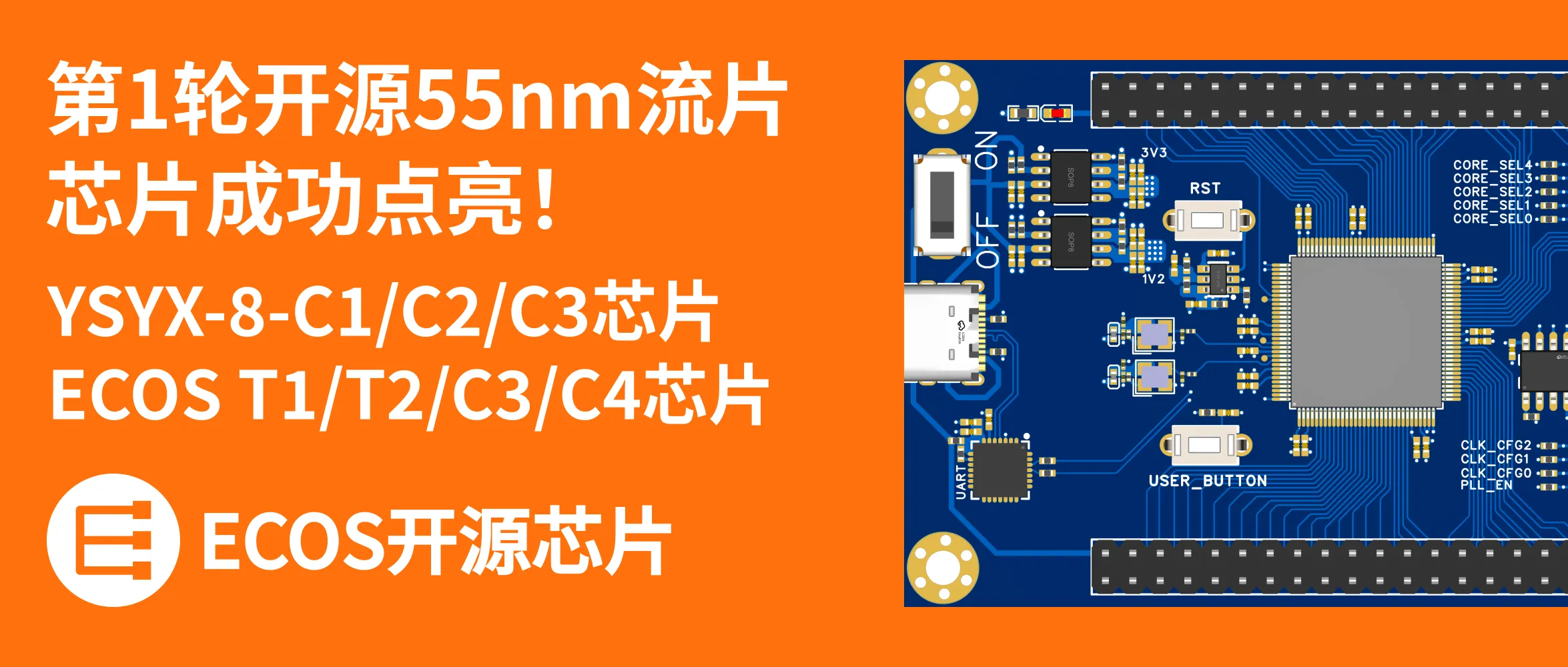
The ECOS Team is proud to announce the official release of the world's first open-source PDK based on 55nm process technology! We are deeply grateful to ICsprout for contributing the world's most advanced, tapeout-ready open-source PDK at the time of release, marking a significant milestone in the history of open-source chips (glory to ICsprout). The open-source nature of ICsprout 55nm Open Source PDK (hereinafter referred to as this PDK) completely changes the high-barrier, high-cost predicament of traditional chip design. It provides universities, research institutions, and the open-source community with a complete pathway from chip design to tapeout manufacturing through open sharing, enabling researchers and developers to transform their imaginative design ideas into actual physical silicon wafers. Furthermore, thanks to the advanced nature of the 55nm process node in the open-source chip field, the complexity and flexibility of future open-source chip design will significantly increase, providing strong support for promoting the construction of the open-source chip ecosystem and the cultivation of chip talent.